Sunday, September 5, 2021

How I teach the Declaration of Independence


Students are exposed to challenging content all throughout their lives. However, the middle school adds in a few extra challenges. Between friendship issues , puberty, and self-esteem, students are really struggling 😭! Therefore, it is key to bring in engaging ways to teach the challenging content. Additionally, it greatly helps to build connections 🤝in order for students to relate to the content. For example, they may love to celebrate Independence Day on July 4th 🎆 but not know the true meaning behind it. Thus, the 3 steps below will be incredibly helpful when teaching the Declaration of Independence!


1. Use the Comparison of a Couple Breaking Up

When teaching the Declaration of Independence, it will be important to bring in a comparison that middle school students will understand. Hence, explain this as a couple breaking up 💔. Now, some middle school students may not have personally been in a relationship yet. However, they have seen many breakups on TV 📺, in their own family 👪, or with a friend 👦. Therefore, it is a connection they can truly understand.


When first starting this comparison, ask students: What would be some reasons you would break up with someone? For example, there may be distance issues between the two people ✈. Or, there may be problems with communication 🤐, happiness, and respecting each other's decisions. Unfortunately, problems may become so bad that an apology just isn’t enough 🚫. There needs to be a formal separation and end of the relationship. By making this comparison, students will have a strong understanding of why the Declaration of Independence was needed. In order to truly excite your students, be sure to play Too Late To Apologize: A Declaration  ! Students will love the new lyrics to this well-known song 🎵.


2. Sections of the Declaration of Independence 

After students gain an understanding on why the Declaration of Independence was needed, it is time to dive deeper into the content. If the relationship comparison really connected with students, this step can even be explained as a divorce 💔. Specifically, compromises have to be worked out in order for all involved parties to come to an agreement 👍. Just as adults have to communicate and compromise, the 13 colonies had to do the same.


In order to break down the Declaration, this Close Reading and Text Analysis resource does an incredible job at explaining the different components. Here, students are provided three methods for decoding a really complicated text . Additionally, they use cooperative learning for analyzing the text 📕. By doing this, the reading 👀 is not so overwhelming. Then, they will listen to music to see Britain’s reaction. Since many students love music 🎵, this is a great way to help them understand the content. After this, students will be guided to depict grievances against King George. This resource does an incredible job at taking a document made of a ton of words and really simplifying them down to the most important aspects.


3. In-Depth Review of Grievances

After explaining what the Declaration is and how it is set up, it is time to move onto complications that arose. This in-depth review will focus on grievances and what they meant. Therefore, by doing this after the Close Reading and Text Analysis resource 👀, students will already have a general idea on this topic. Now, students can dive into the deeper content. To do this, they can explore different grievances, such as colonist participation in government and law enforcement, and separate them into categories. For example, categorize based on political, social, or economic aspects. These three are key issues in any major decision-making.


In order to help students really understand how grievances develop, it can be helpful to look 👀 at different parts of the American Revolution. For instance, the  Articles of Confederation Drag and Drop Activity is such a hands-on way 💻 for students to explore complex topics. Additionally, the activities will help students see the 👆 ups and downs 👇 that occurred during the establishment of the United States. Here, there are activities on the strengths and weaknesses of the Articles of Confederation and even the Northwest Ordinance.


The Declaration of Independence is such a complex topic to learn about. There are many people involved 👴👨👴 and several reasons for why it happened. Furthermore, there are endless complications that occurred during the Declaration development. Therefore, these 3 engaging strategies will greatly help break down the topic into one that all students can understand!


Want some freebies? Join my email list for exclusive social studies freebies and to to be notified of all the interactive lessons coming up! 


Saturday, August 7, 2021

Teach The 13 Colonies Like A Champ With The Help Of These Tips


A chalkboard, globe, pencils, and an apple


The founding of the 13 colonies did not happen overnight. Additionally, it was not a smooth process 💣💥 There is just so much to teach middle school students about how America was actually developed. Additionally, this essential content occurs at a time in students' lives where their minds 🧠 and bodies are rapidly changing. Due to this, it is so important to incorporate their own interests, such as technology, when talking about content that occurred long ago. By following these 3 tips below, teaching about the 13 colonies will be interesting, rigorous, and thorough! 🙌


Explain the Founding of the 13 Colonies

The majority of middle school students 👦👧will not really know how America was formed. Additionally, many students may think all 50 states formed at once. Therefore, one of the joys of junior high 🏫 is teaching students how the world did not instantly develop. There were trials, tribulations, and a lot of compromises 🤝.


When teaching about the 13 colonies, it is important to start back at how they were founded 📓. One way to do this is to provide a quick overview. Middle school students do not have a long attention span. Therefore, this short video 🎥 on The Founding of the 13 Colonies is the perfect one to show. While it is short, it is powerful! It includes an incredible overview on how the colonies came about with strong visual aids.


Lay a Foundation at the Start of the Year

One of the goals of history 🌎 is to learn about the past and avoid making the same mistakes. Additionally, many concepts build upon each other 👷. Therefore, in order to learn about the individual colonies, a solid foundation should be taught from the beginning of the year. Students are going to consistently come back to the 13 colonies, so it is important they have a strong understanding 💯.


The 13 Colonies Drag and Drop resource is perfect 👍 to incorporate in lessons in order to ensure students truly know detailed information 🔍. This resource is best done after students have a general overview of the founding and the names of the colonies. This is due to how much information is packed into this digital resource 💁. Students will love 💖 the interactive component of drag and drop 💻 while learning 15 different aspects of the colonies! For example, students will learn about the reasons for founding, cash crops 💰🍞, and influential people. Students will love getting to have an in-depth exploration of the 13 colonies with an interactive resource!

a picture of parchment paper that a charter could be written on


Interactive Activities

Whenever students are engaged, they learn the information better 🧠. Ultimately, they are more focused 👀 on what is being taught versus daydreaming or doodling. Therefore, make activities interactive! For instance, in the resource above, students could have listened 👂 to a lecture about that information. However, the truth is that many middle school students would have been bored and ignored 😒😩 what was said. Hence, the drag and drop element is a great way to keep students focused and interested in the lesson!


Additionally, the Jamestown Online Adventure is a great way to challenge students. Here, they create their own colony 🏘 with the help of the London Company’s instructions. They can even ask other colonists and Native Americans for advice. By the end, students will see how hard it was to establish the colonies 😵 and common mistakes that were made.


students gathered around a computer working on an engaging activity together

Lastly, if activities are interactive, there is no worry about having to quickly change plans. If classes have to go virtual 💻, everything will be ready. Additionally, if students need to socially distance themselves 👦🠈🠊👧, they can each complete their own activities while still having fun in the classroom!


There is so much information to include when teaching about the 13 colonies. Between why the colonies were needed to the ups 👆 and downs 👇 that were constantly occurring, students can become confused 😕. However, by following the 3 tips above ✅, students will be excited to learn and they will be focusedengaged, and eager for the next lesson.


Want some freebies? Join my email list for exclusive social studies freebies and to to be notified of all the interactive lessons coming up! 

Saturday, June 19, 2021

Back to School for the Social Studies Classroom

 Know the 3 ironclad techniques to improve back to school


After soaking up some much-needed sun and relaxation, now it’s time to plan for such an exciting time: Back to School!📓📚 I’m hoping your district will have more normalcy back this year than the craziness that transpired the past 2 years. However, even if it doesn't, there are a few aspects to focus on as the first day approaches. The 3 strategies below will help ensure the next school year starts with positivity, engagement, and organization!💓😀👍


Why You Should Get to Know Students starting on the First Day of School

To help make sure you have a good year, it’s so important to get to know your students! When positive relationships are developed, everyone is happier to be in the classroom. Also, students are often more driven to complete work when they know the teacher truly cares. To accomplish this during the first week of school, spend some time incorporating get-to-know-you activities into the lesson. Now, I know it’s hard to think about doing this when your year is jam-packed with content that you HAVE to get through. However, building relationships creates a positive classroom atmosphere and makes classroom management easier on you.

 As one additional tip, let your students get to know you! Share some important things in your life, such as your favorite place to visit 🗽, hobbies 🎳, and anything about your family 👶. Students want to get to know us just as much as we want to get to know them! 


How you should get to know your students 

There are so many icebreakers available you could use to get to know students! For example, this If I Were a Country resource is a perfect way to truly get to know your junior high students. Even better, all of the information is related to social studies content! Students will be able to tell the teacher and class all about their Independence Day (birthday) 🎂, favorite climate, and agriculture (food) 🌮. Students can also create their own flag 🚩 and timeline 📅of their life. This resource is chock full of creative ways to use social studies terms while getting to know your new class.


Preparing Sub Plans

No matter how prepared teachers can be, life happens! You never know when a sick day will pop up, and sub plans are rarely easy to come up with. To help keep life calm during a chaotic time, it’s vital to have sub plans in order. It’s best to do this at the start of the year to guarantee a lesson is ready whenever something comes up last minute.

 One incredible FREE resource for the social studies classroom is 10 Supreme Court Cases Every Teen Should Know. Here, there are high-interest cases and articles from the New York Times. Additionally, there are lesson procedures, multiple graphic organizers, and answer keys ready to go. This way, teachers can print these packets at the start of the year and have everything ready to ensure students are still learning when there is a substitute.


Content Review

Summer learning loss is real! After a tumultuous year, content review for any subject is essential  at the beginning of the year. With any luck, students will quickly get back into the swing of things and be able to recall previously learned content.

 To make review exciting, a content “boot camp” is a creative route to take. For example, this Social Studies Skills Bootcamp provides a foundational review for 17 topics, including state identification 🗺 and geographic land features 🗻. Furthermore, there is also a review on latitude and longitude, landmarks 🗽, and presidential trivia. Students will have a blast reviewing in this exciting boot camp format!


Back-to-school is such an exciting, emotional, stressful time. There is always a sadness leaving summer but excitement to be back in the classroom. However, it can be emotional and stressful to get everything prepared for students before the first day comes. Therefore, these 4 strategies will help ensure all students and teachers have the best start to the school year!


Want to get ALL the latest tips and tricks for your social studies classroom? Join my email list and get everything sent straight to your inbox! You will also receive freebies for blog exclusive subscribers!  


Tuesday, September 1, 2020

How to use Task Cards in Your Classroom


Everyone mentions task cards and you see them ALL. THE. TIME. If you haven't jumped on the task card bandwagon, you should because they are awesome! Why? Because they are a review for the students that can go over a broad or specific topic. I love them because answer sheets and questions are already included so they can be taken for a daily grade. 


1. White board review  I absolutely LOVE using this throughout the day or the week. Even better, task cards are great to use with white boards. Students write their answer on the white board, then show it to the teacher at the same time. It gives you instant data on how many students know the answer and what they might still be missing. Check out my blog post on how to use whiteboards in your class!

ex:

(teacher) What are the 3 causes of the Civil War?

(students write the answer on the white board and show it to the teacher on the count of three)

as a teacher, I notice that the students know that two of the causes are slavery and states’ rights, but many of them are forgetting about sectionalism. I know that I need to review that more in depth with them

2. Stations there are two main ways to use task cards for stations. 
  • (one topic) put 3-5 task cards at each station and have students rotate throughout the stations in order to break up the monotony of doing all the task cards at once. It also helps students not feel overwhelmed having to complete all of them
  •  (2+ topics) separate the task cards by topic and set up the stations according to that topic.

ex: when reviewing science, you could put 3 space questions at a station and add images/paraphernalia from NASA. Another station on earthquakes could have pictures of the San Andreas fault in California or a video of the aftermath in Japan.

3. Quiz Quiz Trade With this activity, students are given one task card and must look up the answer before them begin. Students then go around the room and quiz another student and trade task cards when done. 

This is great for lower students because it makes them the “expert” with that task card. Students get to re-teach another student and helps students take ownership of the question/topic. You can also add an answer sheet for accountability. Great for the on-task class!


4. Scoot!  a more organized form of review. Each student has one task card. Each student also has an answer sheet. Everyone completes their own task card and write the answer down. After an allotted time (usually 1 minute), students pass the task card to the next person in their row. This is a great way to use task cards for the talkative classes or the classes with more behavior issues because everyone get the same amount of time, and there is less getting up/moving around. try to make it in a circle so the last student doesn’t have to run across the class to hand off the task card to the next person.

Check out the video below for an alternate way to play Scoot!


5. Back to Back  This is activity is a fan favorite because it gives students interaction. It's a  mix of scoot and QQT. Have students partner up and give them their answer sheet on a clip board. If you have a subject like math or science, add an extra piece of scratch paper to do any calculations on. Then, the students stand back to back, but where they can both see the screen at the same time. 

When you display the task card on the screen, the students have 30 seconds- 1 minutes to write their answer down on their answer sheet. when time is up, they turn and face their partner. then, they compare answers with their partners. This is great because it gives them a chance to work the problem out on their own before they discuss with their partner. It is also an easy way to collaborate and re-teach if needed. 

Bonus remediation (small group or one-on-one). after school tutorials, pick out 3 cards. the student picks 2 that they answer. continue until they have gone through all the cards. then, at the end, take the cards they didn’t answer and work with them on each task card one by one. this helps students filter out the material they know so you can pinpoint where they need help.


teacher using task cards with students


Tuesday, July 21, 2020

Building a Sense of Community in Your Middle School Classroom

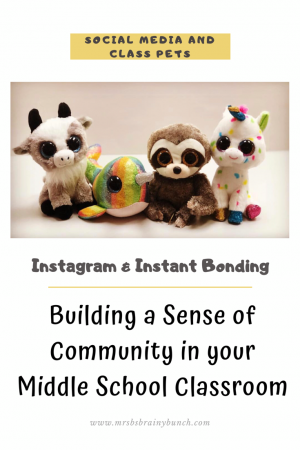
INSTAGRAM AND INSTANT BONDING
How an Instagram of four stuffed animals warmed the hearts of even my toughest 8th graders.

I am so excited to have a guest post this month from Robin of Mrs. B's Brainy Bunch! She is a fantastic ELA teacher from New England she is one of my favorite people. She has had great success using class pets in her classroom, so check out how she implements them with her students.

Instagram image of the class pets


THE INTRODUCTIONS


a long New England winter, and you get CLASS PETS. I can’t pinpoint the moment the idea came to me, but I vividly remember my husband’s reaction as I started ordering stuffed animals from Amazon. “Stuffed animals, for your 8th graders?” But my students are rarely surprised by my antics, and I knew they would be on board. Strengthening relationships among the various cliques in middle school is hard, but possible. Building a sense of community in my classroom is essential because when students feel like they belong, they learn!


IT ALL STARTED WITH FLAT STANLEY

I remember when my son was in the 2nd grade, and we received Flat Stanley in the mail from my nephew in Florida. For those of you who don’t know Flat Stanley, it’s a children’s book about a boy who is flattened by a bulletin board, and finds being flat brings endless possibilities. Our assignment was to show Flat Stanley around our Rhode Island town and take pictures of his adventures. When Stanley returned to Florida, he had been on a hayride in a pumpkin patch and out to dinner at our favorite Chinese restaurant. I hoped this cute childhood project would translate to my 13-year-old students. My mind began to race with all the adventures our class pets could go on with my 105 students!

SOCIAL MEDIA AS THE HOOK
Instagram image of the narwhal

Instagram image of the goat


When it comes to social media, I’m what my students call “old school”. I use Facebook to keep in touch with family and childhood friends, but that’s about it. And as my students love to point out, only “old” people use Facebook. I knew Instagram would be the perfect place to share our photos, so I’d need to learn how to use it. Even though my knowledge of Instagram was sparse, I could take a good photo and use filters… so the pets had their first photo shoot.


OUR FRIENDS NEEDED NAMES

The students arrived Monday morning to the plush faces of the Class Pets. I explained that wherever they took the pets, if they sent me pictures of their adventures, I’d post them to our Instagram page. For safety reasons, the only rule was there couldn’t be any people in any of the pictures. But before the pets could leave school on their first adventures, they needed names. I sent the students a Google form (attached for you to make your own) with pictures of each pet and they began listing possible names. When the votes were tallied, these were the names selected.

Instagram image of the pets


Aidan was named after a favorite student on the team who was lovingly called The Goat. Flash was the perfect name for the sloth as we were studying irony, and Bubbles and Sprinkles rounded out the foursome. I didn’t know the ins and outs of Instagram; however, I stood in front of 105 young adults who did! They taught me how to swipe up, left, and right, as well as post Instagram Stories.

NEW ENGLAND SPORTS FANS

My students began bringing the pets to all of their sporting events. They became mascots for every soccer, softball, basketball, and hockey team, and even their teammates from other schools began following the pets on Instagram. Each of the pets was invited to a Super Bowl Party and cheered on Tom Brady and The Patriots as they won their 6th Super Bowl.

Instagram image of the goat
******
Instagram image of the sloth

DISCOVERING SOMETHING NEW

The pets made the rounds participating in the students’ hobbies from playing chess to drama club to learning the violin, drums, and piano. They learned to play cards, cook, and do ballet. And on one especially cold night, Bubbles was given a sweater just his size. As the pets learned how to play Minecraft and Fortnite, the conversations among the different groups of gamers began. Which was better: PS4, XBOX or PC? Before I knew it, they were exchanging gamer tags to play together after school.

Instagram image of the goat
******
Instagram image of the narwhal


SHOWING THEIR CREATIVITY

I knew my students were imaginative, but I wasn’t prepared for the student who was doing her homework on The American Revolution to have Bubbles battle the Red Coats. Bubbles was an immediate favorite as students used his tusk to play ping pong, fence, and sing along to “The Narwhal Song”.

Instagram image of the narwhal
*****
Instagram image of the narwhal


THE UNEXPECTED

Each week I saw the followers on Instagram grow as the pets made their way into the lives of my students. The pets attended birthday parties, movies, and the theater, but I was not expecting the students’ parents and siblings to follow as well. One morning a student left Flash in the car, and her mother brought him to her job as a financial planner… and sent me pictures to post. Another week I got an email from a parent asking if Flash could come home with her son that weekend because they had a lot of fun activities planned for St. Joseph’s Day. This little community far exceeded the walls of Room 210.

Instagram image of the sloth
*****
Instagram image of the sloth

#BRINGBUBBLESHOME
Instagram image of the narwhal

The pets traveled all over the country from vacations to Kentucky and Florida to soccer tournaments in New Hampshire and Cape Cod. They even accompanied the returning RI State Science Olympiad Team to nationals in Cornell, NY. So, it was not a surprise when one went missing, but it warmed my heart to see the students sharing an assortment of hashtags about Bubbles disappearance.


Come spring, a new friend came to town. He was Gothic in nature, and the students decided on the name Midnight. Thankfully, Bubbles was found under a student’s bed by their cleaning lady. What I thought would be a fun weekend activity began to work its way into my class. Students began grabbing the pets during a test or a particularly tough day. They would even face the pets towards the TV during a movie so they could watch too. I feared the pets might only appeal to the girls on my team, but it was the boys who showed the most heart. As the year came to a close, I had to decide what to do with the pets. Although I posted the pictures to my Instagram page, these were not my pets.


Image of a dragon
*****

Image of a dragon


FINDING NEW HOMES

In the end, the pets were adopted by deserving students. The final Instagram post read:
The pets belong to the class of 2023, so it’s only right that they follow you to the high school. If you think you can give one of the pets a good home, send me a message with the pet you would like to adopt, and why you think you can give it a good home.

The applications were as sweet as their tender hearts. “I think my home would be a good home for Bubbles because she will always be busy with my little sister, and she will always be loved unconditionally.”


Another application read, “I believe I could provide Flash a good home because I have many stuffed animals he can become friends with, and everyone in my house will enjoy Flash very much.”


SENSE OF COMMUNITY

To say the students had fun with the Class Pets is an understatement. And as teachers know, kids learn better when they’re having fun. Middle school is a turbulent time for most teenagers, and they are craving a place where they belong. When students share their love of Dungeons and Dragons and old school New Kids on the Block, it’s because they feel comfortable being themselves. When students feel safe, they are more willing to take chances: raising their hands, sharing their ideas, reading a new book, writing a poem, DREAMING BIG

Community happens when you feel like people see you, hear you, and accept you for your unique ideas and quirky ways. I feel that in my classroom everyday, and so I know more silly and creative ideas lie ahead. Years from now, my students may not remember the correct use of a semicolon or how to correctly cite in MLA format, but as the old adage goes, they’ll remember how they felt in my classroom. And in my book, that’s a success!


EVERYTHING TO GET YOU STARTED WITH YOUR OWN CLASS PETS!

The Letter to Parents is completely editable so you can make it your own. You can decide how best you want the pictures sent to you be it school email or DM on Instagram . . . or both.
Naming the Pets is a Google Form that will make it easier for you to have the students name the pets. Simply swap the pictures and you are ready to go.
Request for Adoption is also a Google Form that will make it easier for you when the school year ends, and the pets are adopted by your students. Again, swap the picture and you are ready to go.

#CLASSPETCONNECTIONS
Due to the warm response of my blog post, I created a hashtag for teachers where we can share our favorite pet photos with fellow teachers around the world. When you post your photos on Instagram, use the #classpetconnections so we can see all the big and small adventures in which the pets embark. Happy Trails!

ACTIVITIES FOR YOUR STUDENTS AND CLASS PETS


If you are incorporating Class Pets into your classroom, these 12 MONTHLY ACTIVITIES are for you. These engaging activities help the students express themselves in new and creative ways.


Pinterest Pin of the class pets


Summarizing Like a Boss: Five Strategies to Up Your Game

  Attention teachers! Do you find yourself receiving long-winded paragraph answers from your students that seem to go nowhere? Does it seem ...